Today’s chosen theme is “Composing Stunning Nature Shots While Hiking.” Lace up, lift your eyes, and let every bend in the trail become a frame. Join our community by subscribing for fresh trail-composition prompts and share your best hiking photo stories in the comments.
Turn Trails into Leading Lines
Use the trail itself as a visual invitation. Position the path to sweep from a corner toward your focal point, like a lone pine or mountain. A subtle shift of your stance can align ridgelines into elegant guides that lead viewers naturally through the photograph.
Turn Trails into Leading Lines
Place a textured rock, wildflower cluster, or your hiking boots in the foreground to establish scale. This anchor creates depth by contrasting near details with distant peaks. Adjust your height—crouch low—so the foreground feels intentional, not accidental filler.
Chasing Light on Foot
Start earlier than feels necessary. Study topo maps to predict where the sun will dip behind ridges. Keep a headlamp for the return and pre-visualize compositions at midday. When warm light arrives, you’ll already know where to stand, saving precious, glowing minutes.
Stack interest from front to back: a mossy log, a hillside of ferns, and distant mountains. Use a slightly narrower aperture to keep layers legible. When each plane has its own texture or tone, the viewer feels drawn deeper into the scene, step by visual step.
Look for branches, cave mouths, arching roots, or canyon walls to frame your subject. Frames focus attention and add context without clutter. Shift your position so the frame forms clean edges, then breathe out and release the shutter when the wind briefly stills.
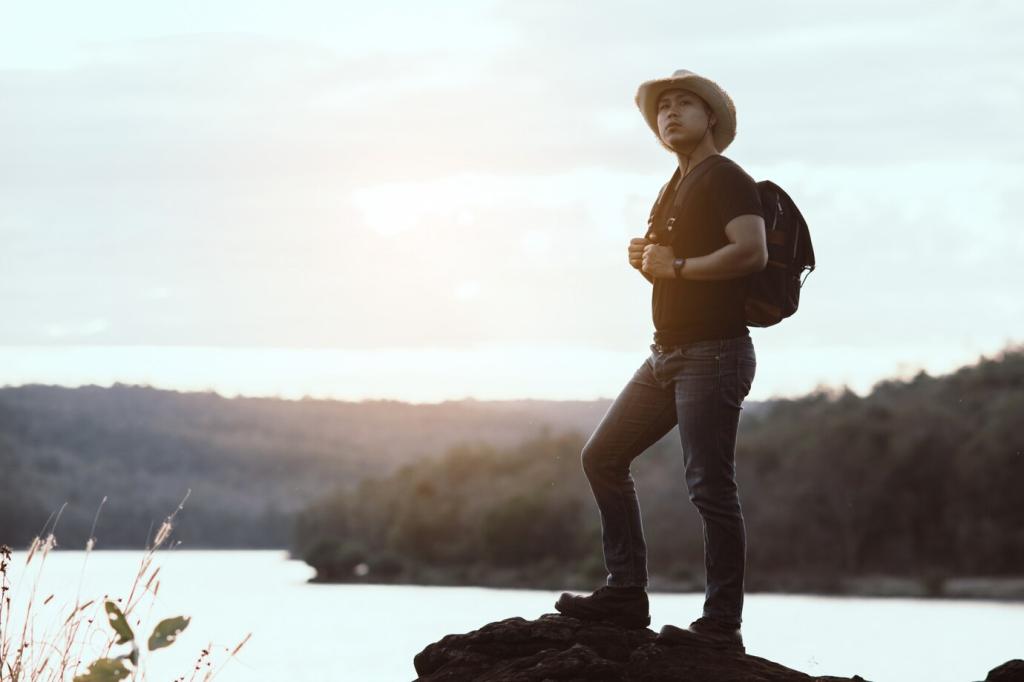
Embrace open sky, water, or snowfields to simplify. Negative space lets your subject stand proud and sets a calm tone. Place a lone hiker or tree against a quiet backdrop. Invite readers to share minimalist trail photos that relax the eye yet still tell a story.
Polarizers for Skies, Water, and Foliage
A circular polarizer cuts glare on wet leaves, deepens skies, and reveals river stones. Rotate it until reflections calm just enough. Be mindful of uneven polarization on wide lenses, and invite friends to compare versions to learn exactly where the sweet spot lives.
Seek complementary pairs like orange larch against blue mountains, or analogous greens along ferny creeks. Let gear accents—jackets, tents—act as color punctuation. Curate hues in the frame so the mood feels intentional rather than accidental or visually noisy.
Think in sequences: the trail sign, first light on switchbacks, a snack break, summit joy, and the quiet walk out. Small connective frames make the story feel lived. Invite readers to assemble a five-frame hike narrative that flows like footsteps through memory.
Include People for Scale—Respectfully
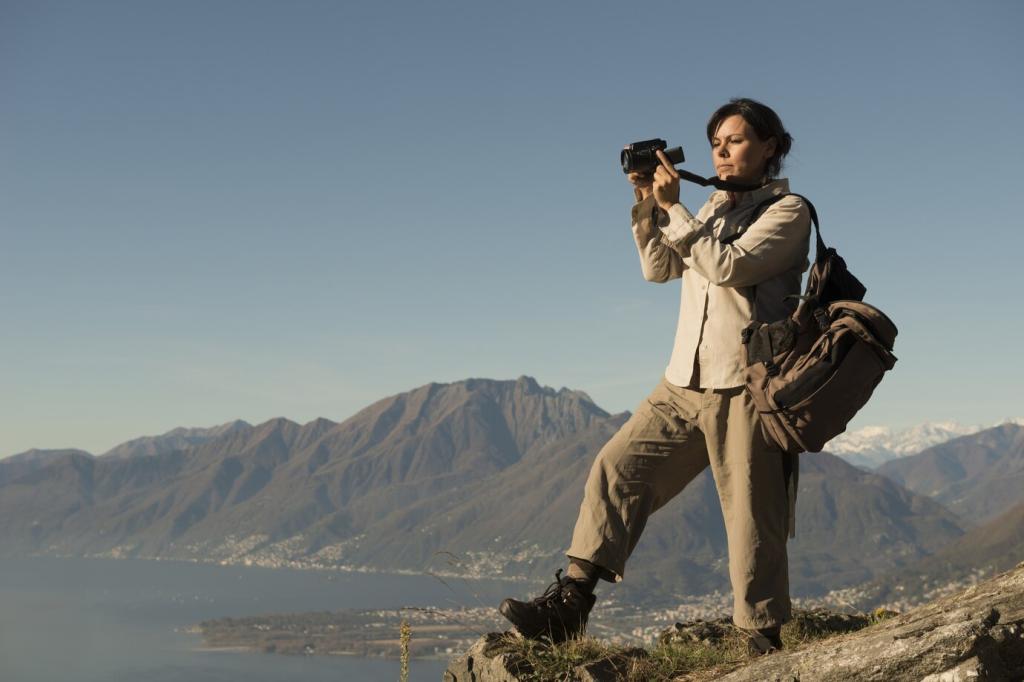
A tiny hiker against vast cliffs communicates grandeur and humility. Ask permission, avoid obstructing the trail, and keep candid moments authentic. A ranger once reminded me: the best portraits show the place’s character as clearly as the person’s expression.
Leave No Trace Composition
Compose without trampling fragile plants or building props. Stay on durable surfaces and resist shortcut social trails. Beauty isn’t worth a footprint that lasts decades. Encourage comments about low-impact techniques so our collective images honor the landscapes we love.